Solar pumps are rapidly transforming Indian agriculture by providing farmers with clean, reliable and low-cost irrigation solutions. Rising diesel prices, electricity shortages and increasing focus on renewable energy have made solar-powered irrigation systems an important part of India’s agricultural future.
In this article, Rural Duniya explains solar pump prices in India, subsidy support, trolley price, motor and controller cost, PM Kusum scheme, benefits, SDG linkages, government support and comparison with other countries.
What is a Solar Pump?
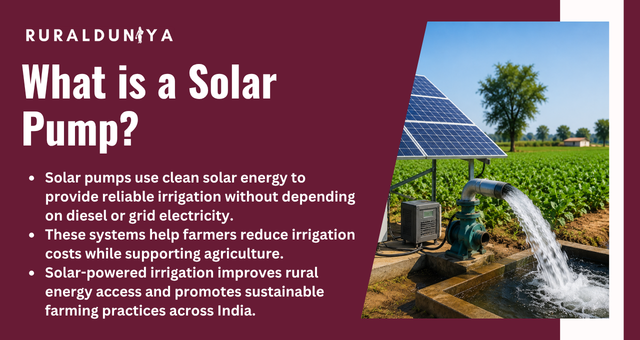
A solar pump is a water pumping system powered by solar energy instead of diesel or grid electricity.
The system generally includes:
- Solar panels
- Solar controller
- Water pump motor
- Mounting structure
- Battery (optional)
They are mainly used for:
- Agricultural irrigation
- Borewell water lifting
- Drip irrigation systems
- Rural drinking water supply
- Livestock and fisheries
It reduce farmers’ dependence on diesel and irregular electricity supply.
Benefits of Solar Pumps
It provide multiple economic and environmental benefits.
Major Benefits
- Reduced diesel costs
- Lower electricity bills
- Reliable daytime irrigation
- Low maintenance
- Environment-friendly energy
- Long operational life
- Better irrigation access
- Increased farm productivity
It also help reduce dependence on erratic power supply in rural areas.
Solar Pump Price List in India
The price of pumps in India depends on:
- Horsepower (HP)
- Pump type
- Solar panel capacity
- Installation area
- Brand
- Battery requirement
Approximate Solar Pump Price List
| Capacity | Approximate Price Range |
|---|---|
| 1 HP | ₹70,000 – ₹1.2 lakh |
| 2 HP | ₹1.2 lakh – ₹1.8 lakh |
| 3 HP | ₹2 lakh – ₹2.5 lakh |
| 5 HP | ₹3 lakh – ₹3.5 lakh |
| 7.5 HP | ₹4 lakh – ₹6 lakh |
Prices vary depending on subsidy availability and state implementation systems.
Solar Pump Price 1HP
It generally costs:
- ₹70,000 to ₹1.2 lakh before subsidy
The final price depends on:
- DC or AC motor type
- Surface or submersible pump
- Solar panel quality
- Installation location
Small farmers and kitchen garden users commonly prefer 1HP systems.
Solar Pump for Agriculture Price
They are available in multiple capacities depending on irrigation needs.
Cost Factors
- Farm size
- Borewell depth
- Water requirement
- Pump capacity
- State subsidy support
Under PM Kusum and state schemes, farmers often pay only a small percentage of the actual cost.
Solar Pump Subsidy in India
The Government of India provides subsidy support through the PM Kusum Scheme.
Under many PM Kusum implementations:
- Central Government subsidy: 30%
- State Government subsidy: 30%
- Loan support: 30%
- Farmer contribution: Around 10%
In some states, SC/ST and marginal farmers receive even higher subsidy support.
PM Kusum Scheme
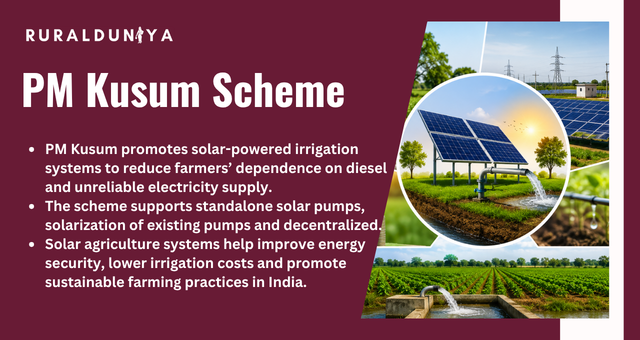
The PM Kusum Scheme (Pradhan Mantri Kisan Urja Suraksha evam Utthaan Mahabhiyan) is India’s flagship solar agriculture programme launched to promote solar-powered irrigation and renewable energy in farming.
Main Components of PM Kusum
- Standalone solar agriculture pumps
- Solarization of existing grid-connected pumps
- Decentralized solar power plants
The scheme aims to reduce diesel consumption and improve energy security for farmers.
Solar Pump Trolley Price
Portable solar pump trolleys are mobile irrigation systems used in:
- Small farms
- Remote areas
- Temporary irrigation setups
Approximate Solar Pump Trolley Price
- ₹40,000 to ₹1.5 lakh
Prices depend on:
- Wheel structure
- Pump capacity
- Solar panel size
- Portability features
Portable trolley systems are becoming popular among marginal farmers.
Solar Pump Controller Price
The solar controller manages power flow between panels and the pump motor.
Approximate Controller Price
- ₹8,000 to ₹40,000
Controller prices vary depending on:
- HP capacity
- AC/DC compatibility
- Smart monitoring systems
- Automation features
Advanced controllers improve pump efficiency and motor safety.
Solar Pump Motor Price
The motor is one of the most important parts of a solar system.
Approximate Motor Price
- ₹15,000 to ₹80,000
Motor prices depend on:
- Submersible or surface type
- Power capacity
- Water lifting height
- Brand quality
Submersible motors are widely used for deep borewell irrigation systems.
Solar Pumps and Sustainable Development Goals (SDGs)
They are closely linked with multiple United Nations Sustainable Development Goals (SDGs).
SDGs Connected with Solar Pumps
| SDG | Relation |
|---|---|
| SDG 2 | Supports food security and agriculture |
| SDG 6 | Improves water access |
| SDG 7 | Promotes clean energy |
| SDG 8 | Supports rural livelihoods |
| SDG 13 | Reduces carbon emissions |
Solar irrigation systems are increasingly seen as climate-resilient agricultural infrastructure.
Government Support for Solar Pumps
The Government of India and state governments are heavily promoting them.
Government Support Includes
- PM Kusum subsidy
- State solar schemes
- Loan support
- NABARD financing
- Agricultural energy reforms
- Solar feeder schemes
Several states including Rajasthan, Maharashtra and Uttar Pradesh are scaling solar irrigation rapidly.
Solar Pump Comparison with Different Countries
India is now among the world’s leading countries in solar agriculture deployment.
India
- Large subsidy support
- PM Kusum Scheme
- Rapid rural adoption
- Focus on irrigation
China
- Large-scale solar manufacturing
- Advanced solar technology integration
- Strong renewable infrastructure
Israel
- Highly efficient drip irrigation integration
- Smart water management systems
African Countries
- They mainly used in off-grid rural farming
- International donor-supported projects common
USA
- Commercial-scale solar irrigation systems
- Advanced automation and precision agriculture
India’s model is unique because it combines:
- Farmer subsidy
- Rural electrification
- Irrigation support
- Renewable energy transition
Challenges of Solar Pumps
Despite rapid growth, several challenges remain.
Major Challenges
- High initial cost
- Maintenance awareness
- Water over-extraction risk
- Technical service gaps
- Financing barriers
- Land requirement for panels
Experts also warn that uncontrolled solar irrigation may increase groundwater depletion if water management systems are weak.
Future of Solar Pumps in India
India’s solar pump agriculture sector is expected to grow rapidly in the coming years.
Recent discussions around PM Kusum 2 indicate that the government plans to further expand solar irrigation infrastructure.
Future growth areas include:
- Smart irrigation systems
- AI-based pump monitoring
- Community solar irrigation
- Agrivoltaics
- Solar-powered micro-irrigation
They are increasingly becoming a major part of India’s clean energy and sustainable agriculture strategy.
FAQs
What is the price of a 1HP solar pump in India?
A 1HP pump generally costs between ₹70,000 and ₹1.2 lakh before subsidy.
What subsidy is available on solar pumps?
Under PM Kusum, farmers may receive up to 60% subsidy along with loan support.
What is PM Kusum Scheme?
PM Kusum is a government scheme promoting solar-powered agriculture pumps and renewable energy in farming.
Are solar pumps beneficial for farmers?
Yes, they reduce diesel costs, improve irrigation access and support sustainable agriculture.

Nishank is a social impact enthusiast with a solid foundation in public policy, micro-enterprise, and agribusiness. Growing up in a farmer’s family has given him a profound connection to rural communities, fueling his passion to empower people towards self-reliance. He completed his undergraduate studies at the Delhi University and earned a master’s degree in Rural Management from National Institute of Rural Development & Panchayati Raj in Hyderabad.