Weather patterns influence farming, water availability, food production and livelihoods across the world. Among the most important climate phenomena affecting global weather is El Niño. From rainfall shortages in India to droughts in Brazil and changing weather patterns in the USA, it can have far-reaching consequences.
For farmers and rural communities, understanding El Niño is particularly important because it directly affects monsoon rainfall, crop yields, irrigation needs and rural incomes.
In this article, Rural Duniya explains El Niño, its effects on India, its relationship with La Niña, global warming, jet streams, seasonal forecasts and what rural households should know.
What is El Niño?
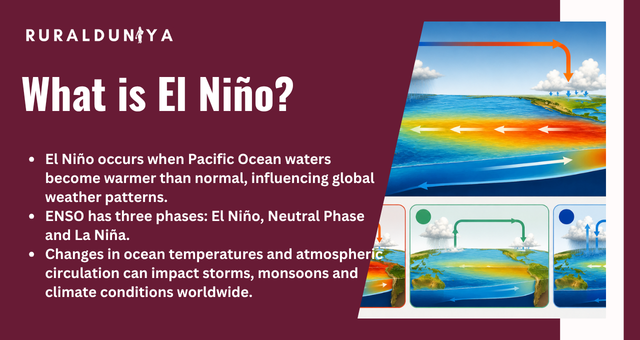
El Niño is a climate phenomenon that occurs when sea surface temperatures in the central and eastern Pacific Ocean become warmer than normal.
This warming disrupts global atmospheric circulation and influences weather patterns across different continents.
The phenomenon occurs as part of a larger climate cycle known as:
ENSO (El Niño Southern Oscillation)
ENSO has three phases:
- El Niño
- Neutral Phase
- La Niña
These phases significantly influence rainfall, temperature and storm patterns worldwide.
El Niño Phenomenon Explained
Normally, trade winds push warm ocean water toward the western Pacific.
During El Niño:
- Trade winds weaken
- Warm water shifts eastward
- Ocean temperatures rise
- Atmospheric circulation changes
As a result, weather systems across Asia, North America, South America and Africa are affected.
El Niño and La Niña
El Niño and La Niña are opposite phases of the ENSO cycle.
El Niño
- Warmer Pacific Ocean temperatures
- Often weaker Indian monsoon
- Higher temperatures globally
- Increased drought risk in some regions
La Niña
- Cooler Pacific Ocean temperatures
- Often stronger Indian monsoon
- Increased rainfall in many regions
- Cooler global temperatures
Both phases influence agriculture and water resources worldwide.
El Niño Effect on India
India is one of the countries most affected by El Niño.
The Indian monsoon provides nearly 70% of annual rainfall for many regions. When it develops, monsoon rainfall may weaken.
Common Effects on India
- Below-normal monsoon rainfall
- Higher temperatures
- Increased drought risk
- Reduced reservoir levels
- Lower agricultural productivity
However, every El Niño event is different, and impacts can vary depending on regional weather conditions.
El Niño and Rural India
For rural communities, it is more than a weather event.
Possible Rural Impacts
- Delayed sowing
- Reduced crop yields
- Water shortages
- Higher irrigation costs
- Livestock stress
- Lower farm incomes
For example, a farmer dependent on rain-fed agriculture in Maharashtra, Rajasthan or Karnataka may face lower crop production if monsoon rainfall declines significantly.
Understanding seasonal forecasts helps farmers make better decisions regarding:
- Crop selection
- Irrigation planning
- Water conservation
- Input investments
El Niño Weather Effects
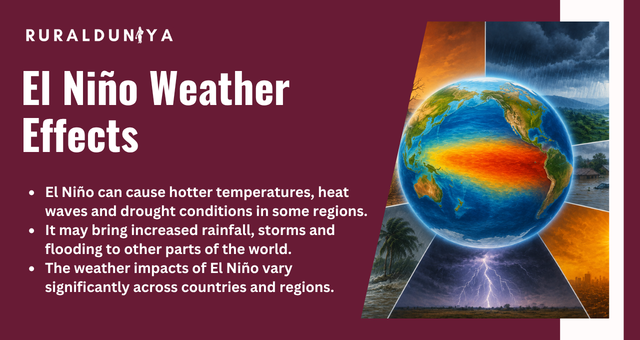
It influences weather across many regions.
Weather Changes During El Niño
- Hotter temperatures
- Reduced rainfall in some areas
- Increased rainfall in others
- Droughts
- Floods
- Heat waves
Its effects vary significantly from one region to another.
El Niño Season
The events typically develop during:
April to June
Initial ocean warming begins.
July to September
Conditions strengthen.
October to December
It often reaches peak intensity.
January to March
Gradual weakening may occur.
The timing is important because it overlaps with India’s southwest monsoon season.
El Niño Winter Effects
It also influences winter weather patterns.
Possible Winter Impacts
- Warmer winters in some regions
- Reduced snowfall
- Changes in storm tracks
- Altered rainfall patterns
In India, winter rainfall patterns may also be affected depending on atmospheric conditions.
El Niño and Global Warming
Many people confuse El Niño with global warming, but they are different.
El Niño
A natural climate cycle that occurs periodically.
Global Warming
A long-term increase in Earth’s average temperature caused primarily by greenhouse gas emissions.
However, it can temporarily amplify global warming effects by increasing global temperatures.
Many recent record-breaking warm years have coincided with strong events.
El Niño and the Jet Stream
The jet stream is a fast-moving air current in the upper atmosphere.
It can alter:
- Jet stream position
- Storm pathways
- Rainfall distribution
- Temperature patterns
Changes in the jet stream often explain why distant regions experience unusual weather during El Niño years.
El Niño Zone
It’s zone is generally located in:
Central and Eastern Equatorial Pacific Ocean
Scientists monitor this region using:
- Ocean temperature measurements
- Satellite observations
- Climate models
Temperature changes in this zone help determine whether El Niño or La Niña conditions are developing.
El Niño in the USA
The USA often experiences significant weather impacts during El Niño.
Common Effects
- Increased rainfall in southern states
- Milder winters in northern regions
- Changes in hurricane activity
- Flood risks in some areas
Weather agencies closely monitor El Niño because of its economic and agricultural implications.
El Niño and Brazil
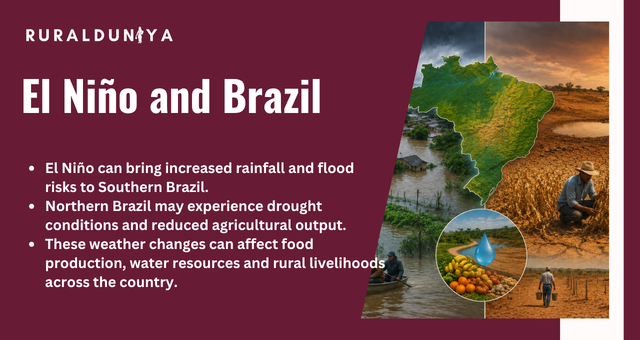
Brazil is another country heavily affected by it.
Possible impacts include:
Southern Brazil
- Increased rainfall
- Flood risks
Northern Brazil
- Drought conditions
- Reduced agricultural output
These impacts affect:
- Food production
- Water resources
- Rural livelihoods
El Niño Records
Several strong El Niño events have been recorded over the past decades.
Notable Events
- 1982–83
- 1997–98
- 2015–16
These events caused:
- Global temperature increases
- Agricultural losses
- Floods and droughts
- Major economic impacts
Scientists continue to study historical records to improve future forecasts.
El Niño Forecast 2026
Climate agencies regularly monitor ocean temperatures and atmospheric conditions to assess it’s development.
Forecasts generally consider:
- Pacific Ocean temperatures
- Wind patterns
- Atmospheric pressure
- Climate models
Farmers and policymakers should rely on official weather agencies for updated forecasts because it’s conditions can evolve rapidly.
Challenges of Predicting El Niño
Although forecasting has improved, challenges remain:
- Complex ocean-atmosphere interactions
- Regional weather variability
- Climate change influences
- Forecast uncertainty
Scientists continuously refine models to improve seasonal prediction accuracy.
How Rural Communities Can Prepare
Rural households can reduce risks through:
Water Management
- Rainwater harvesting
- Farm ponds
- Efficient irrigation
Climate-Smart Agriculture
- Drought-resistant crops
- Crop diversification
- Improved soil moisture management
Information Access
- Weather advisories
- Seasonal forecasts
- Agricultural extension services
Preparedness can significantly reduce the economic impact of weak monsoons.
Why El Niño Matters
El Niño is one of the world’s most important climate phenomena because it affects weather, agriculture, water resources and economies across continents.
For India’s rural population, understanding it can help improve farming decisions, strengthen resilience and reduce climate-related risks.
As climate variability increases, awareness of El Niño and La Niña will become even more important for sustainable rural development.
FAQs
What is El Niño?
It is a climate phenomenon caused by warmer-than-normal sea surface temperatures in the Pacific Ocean.
How does El Niño affect India?
It can weaken the monsoon, increase temperatures and raise drought risks in some regions.
What is the difference between El Niño and La Niña?
It involves warmer Pacific waters, while La Niña involves cooler Pacific waters.
Does El Niño cause global warming?
No. it does not cause global warming, but it can temporarily increase global temperatures.

Nishank is a social impact enthusiast with a solid foundation in public policy, micro-enterprise, and agribusiness. Growing up in a farmer’s family has given him a profound connection to rural communities, fueling his passion to empower people towards self-reliance. He completed his undergraduate studies at the Delhi University and earned a master’s degree in Rural Management from National Institute of Rural Development & Panchayati Raj in Hyderabad.