Ration Card
A ration card is one of the most important government-issued documents in India. It helps eligible households access subsidized food grains under the Public Distribution System (PDS) and serves as an important proof of identity and residence.
In this article, Rural Duniya explains everything about ration cards, including eligibility criteria, online application process, verification, grievance systems, state-specific services in Uttar Pradesh and West Bengal, quota details and eKYC requirements.
What is a Ration Card?
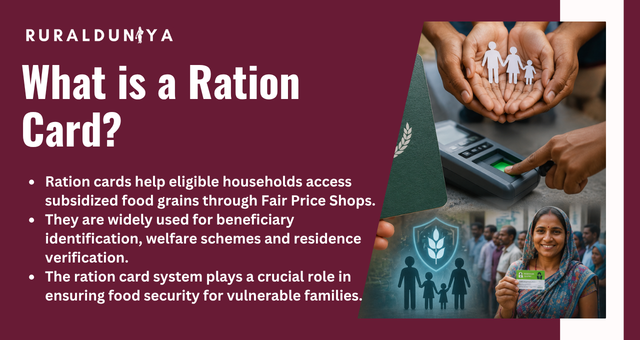
A ration card is an official document issued by state governments that enables eligible households to purchase essential commodities at subsidized rates through Fair Price Shops (FPS).
It is used for:
- Food grain distribution
- Government welfare schemes
- Identity verification
- Residence proof
- Beneficiary tracking
The system plays a critical role in ensuring food security for vulnerable households.
Types of Ration Cards
Different states issue cards based on economic status.
Categories are:
Priority Household (PHH) Card
Issued to eligible low-income families under the National Food Security Act (NFSA).
Antyodaya Anna Yojana (AAY) Card
Issued to the poorest households with higher food grain entitlements.
Non-Priority Household (NPHH) Ration Card
Issued to families that do not qualify under the Priority Household category but are registered in the Public Distribution System.
State-Specific Categories
Many states operate additional categories depending on local welfare policies.
Ration Card Eligibility Criteria
Eligibility varies across states but generally depends on:
- Family income
- Economic status
- Residential status
- Social category
- Existing welfare benefits
Common Eligibility Requirements
- Permanent resident of the state
- Not holding another ration card
- Belonging to eligible income categories
- Meeting NFSA guidelines
State governments periodically update eligibility criteria.
Documents Required for Ration Card
Applicants typically need:
- Aadhaar Card
- Identity proof
- Residence proof
- Passport-size photographs
- Mobile number
- Income certificate (if required)
States may request additional documents depending on local rules.
Ration Card eKYC
One of the most searched topics today is card eKYC.
Governments are increasingly making Aadhaar-based eKYC mandatory to improve beneficiary verification and remove duplicate records.
Benefits of eKYC
- Prevents fake beneficiaries
- Ensures genuine entitlement
- Improves transparency
- Reduces duplication
- Enables digital verification
Beneficiaries can complete eKYC through:
- Fair Price Shops
- CSC Centres
- State portals
- Aadhaar-enabled systems
Ration Card Online Check
Applicants can easily check card status online.
Information Available Online
- Application status
- Beneficiary details
- Family member information
- Card category
- Quota allocation
- eKYC status
Most states provide dedicated online tracking systems.
Ration Card Download
Many state portals now allow citizens to download digital cards.
Download Process
- Visit official portal
- Enter card number
- Verify details
- Download digital copy
Digital cards help beneficiaries access services even when physical cards are unavailable.
Ration Card Quota Details
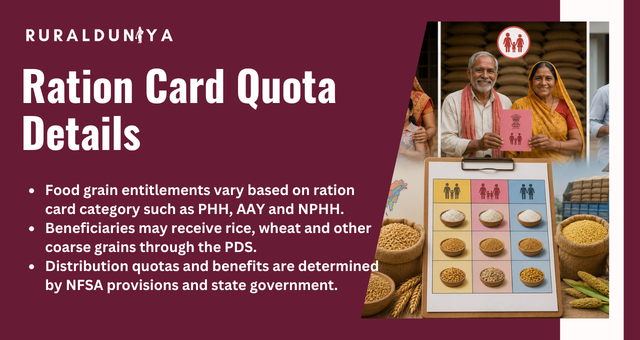
The food grain quota depends on card category and government policy.
Common Entitlements Under NFSA
Priority Household (PHH):
- 5 kg food grains per person per month
Antyodaya Anna Yojana (AAY):
- 35 kg food grains per household per month
Non-Priority Household (NPHH):
- May receive limited or state-specific benefits
- Used as proof of residence and family details
- Commonly issued to middle-income households
Food grains may include:
- Rice
- Wheat
- Coarse grains
Distribution policies may vary across states.
Ration Card Verification Process
Verification is conducted to ensure genuine beneficiary inclusion.
Verification Includes
- Aadhaar authentication
- Address verification
- Family member validation
- Income verification
- Beneficiary cross-checking
The process helps improve targeting and reduce fraudulent claims.
Ration Card Validation
State governments regularly conduct validation exercises.
Validation aims to:
- Update beneficiary databases
- Remove duplicate cards
- Correct family information
- Improve service delivery
Beneficiaries are advised to update records whenever family details change.
Ration Card Village List
Many citizens search for the card village list.
Village-level beneficiary lists help citizens:
- Verify inclusion status
- Check household details
- Confirm eligibility
- Track beneficiary records
Village lists are often available through:
- State food department portals
- Gram Panchayat offices
- Fair Price Shops
These lists improve transparency in food distribution systems.
UP Ration Card Services
Uttar Pradesh has one of India’s largest card systems.
Popular online services include:
- Apply online
- Download card
- eKYC update
- Beneficiary search
- Village list verification
- Quota details
- Status tracking
Millions of NFSA beneficiaries in Uttar Pradesh receive food grains through the state PDS network.
West Bengal Ration Card Services
West Bengal also provides extensive digital card services.
Popular services include:
West Bengal Ration Card
- New application
- eKYC verification
- Digital card download
- Beneficiary search
- Food grain entitlement details
- Complaint registration
The state has significantly expanded digital service delivery in recent years.
Ration Card Grievance System
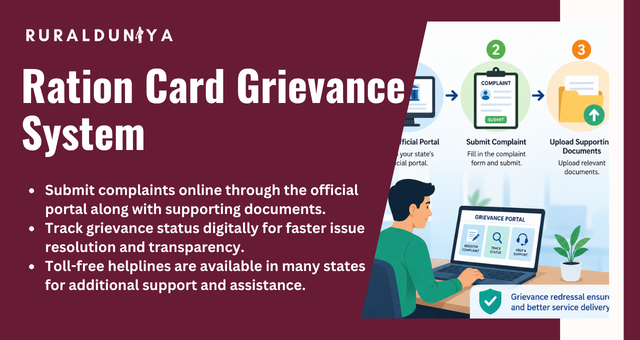
A grievance redressal system helps beneficiaries resolve issues related to:
- Name correction
- Card duplication
- Food grain distribution
- Missing beneficiaries
- eKYC problems
- Dealer complaints
How to File a Grievance
- Visit official portal
- Submit complaint
- Upload supporting documents
- Track grievance status
Many states also operate toll-free helplines.
Ration Card Apply Online
Most states now offer online card application systems.
Steps to Apply Online
- Visit the state food department portal
- Register user account
- Fill application form
- Upload required documents
- Submit application
- Receive application reference number
- Track application status online
Online systems have reduced paperwork and improved transparency.
Importance of Ration Cards in Rural India
It remain a lifeline for millions of rural households.
- Affordable food access
- Household food security
- Social protection
- Support during emergencies
- Access to welfare schemes
For example, a small farmer family in a village may rely on subsidized food grains during droughts, crop failures or economic hardships.
This system helps reduce food insecurity and strengthen rural livelihoods.
Challenges in Ration Card Delivery
Despite improvements, some challenges remain:
- eKYC delays
- Aadhaar mismatch
- Beneficiary exclusion
- Network connectivity issues
- Verification delays
- Documentation gaps
Governments continue to modernize systems to improve service delivery.
Future of Digital Ration Systems
This ecosystem is increasingly moving toward:
- Aadhaar integration
- One Nation One Ration Card (ONORC)
- Digital authentication
- Online grievance systems
- Real-time beneficiary databases
These reforms aim to make food security programmes more efficient and transparent.
Why Ration Cards Matter
The ration card is more than a food subsidy document. It is a critical social protection tool that supports millions of households across India.
By combining food security, digital governance and beneficiary targeting, cards continue to play a vital role in reducing poverty and improving welfare outcomes, especially in rural India.
FAQs
What is a ration card?
It is a government-issued document that allows eligible households to receive subsidized food grains through the Public Distribution System.
How can I complete ration card eKYC?
eKYC can usually be completed through Fair Price Shops, CSC centres or state food department portals.
How can I download my ration card online?
You can download it from your state food department portal using your card number or beneficiary details.
How can I check the ration card village list?
Village-wise beneficiary lists are available through state food portals, Gram Panchayats and local ration distribution offices.

Nishank is a social impact enthusiast with a solid foundation in public policy, micro-enterprise, and agribusiness. Growing up in a farmer’s family has given him a profound connection to rural communities, fueling his passion to empower people towards self-reliance. He completed his undergraduate studies at the Delhi University and earned a master’s degree in Rural Management from National Institute of Rural Development & Panchayati Raj in Hyderabad.