The growing conflict in West Asia and disruptions around the Strait of Hormuz are raising global concerns about a possible food shortage crisis. International agencies, economists and governments are warning that rising fuel prices, fertiliser shortages and shipping disruptions could affect food supply chains.
From wheat and rice production to vegetable prices and food transportation, the effects of war are now reaching ordinary citizens. The biggest concern is that if the conflict continues for a long period, the world could witness rising inflation, reduced crop yields and severe pressure on food security systems.
In this article, Rural Duniya explains the food shortage warning, impact on India and Gulf countries, the role of the Strait of Hormuz, possible predictions, affected countries, challenges, solutions and overall impact on citizens’ lives.
Why is the World Talking About Food Shortage?
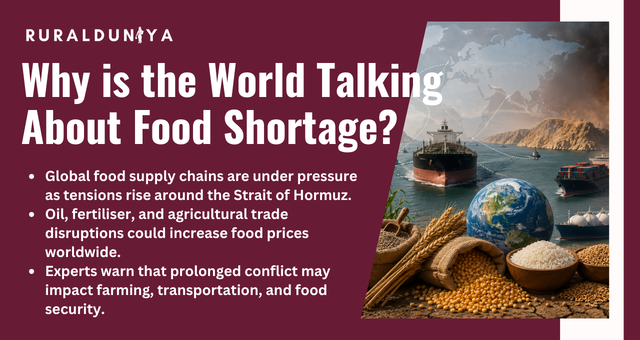
The current concern of food shortage is linked to the ongoing conflict involving disruptions around the Strait of Hormuz, one of the world’s most important oil and shipping routes.
Around 20% of the world’s oil supply passes through the Strait of Hormuz. The region is also critical for fertiliser trade, liquefied natural gas (LNG) and agricultural commodity transportation.
The United Nations Food and Agriculture Organization (FAO) has warned that disruptions in the Strait of Hormuz could create severe consequences for agricultural production and global food prices.
Food Shortage Due to War
Wars affect food systems in multiple ways:
- Fuel prices increase
- Fertiliser becomes expensive
- Shipping costs rise
- Crop production reduces
- Supply chains get disrupted
- Inflation increases
- Imports become costly
The ongoing conflict has already started affecting fertiliser and fuel supplies globally. Several reports suggest that fertiliser prices may rise sharply, impacting farmers across Asia and Africa.
According to Reuters and IMF estimates, prolonged conflict could significantly increase inflation and reduce global economic growth.
Food Shortage in India Due to War
India may not face immediate large-scale food scarcity, but experts believe the country could experience:
- Higher food prices
- Rising fertiliser costs
- Increased transportation expenses
- Pressure on farmers
- Fuel inflation
- Supply chain disruptions
India imports a significant portion of crude oil from Gulf countries. If oil prices remain high, logistics and agricultural production costs will rise.
The Guardian recently reported that rising fertiliser costs linked to the conflict are already affecting farming systems globally.
For India, the biggest risk areas include:
- Fertiliser availability
- Diesel prices
- Food inflation
- Vegetable transportation
- Irrigation costs
- Imported edible oil prices
The government has stated that fuel supply remains stable for now, but it continues to closely monitor global developments.
Food Shortage in Dubai, UAE and Gulf Countries
Dubai and UAE are highly dependent on imported food supplies. Most Gulf countries import a large share of their food from Asia, Africa and Europe.
The war has increased concerns in Gulf countries because:
- Shipping routes are under pressure
- Insurance costs have increased
- Supply chains are slowing
- Fuel prices remain volatile
The Strait of Hormuz is extremely important for UAE, Dubai, Saudi Arabia and Qatar because much of the region’s trade passes through this corridor.
Several humanitarian organisations have warned that disruptions in Gulf shipping routes may affect global aid and food supply systems.
Even though Gulf countries maintain strategic reserves, long-term disruption could increase prices of:
- Vegetables
- Milk products
- Grains
- Packaged food
- Imported fruits
Strait of Hormuz and Global Food Crisis
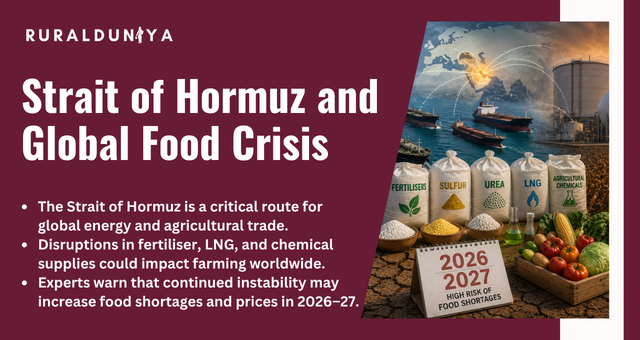
The Strait of Hormuz connects the Persian Gulf to the Arabian Sea and serves as one of the world’s most critical energy and trade chokepoints.
The problem is not just oil.
Large quantities of:
- Fertilisers
- Sulfur
- Urea
- LNG
- Agricultural chemicals
also pass through this route.
FAO officials have warned that delayed fertiliser supply during crop seasons can reduce agricultural yields significantly.
This is why experts fear that food shortages may intensify in 2026 and 2027 if the crisis continues.
Countries Most at Risk of Food Shortage
Some countries are more vulnerable because they depend heavily on imports and fertiliser supplies.
Countries Facing Higher Risk
- Yemen
- Sudan
- Somalia
- Afghanistan
- Sri Lanka
- Bangladesh
- Pakistan
- Low-income African nations
The UN has warned that millions of people may face worsening hunger if global supply chains continue to remain under pressure.
Asian agricultural economies may also suffer because of higher fertiliser prices and fuel inflation.
Food Shortage Warning and Predictions
Several global agencies and analysts have issued warnings regarding:
- Rising food inflation
- Fertiliser shortages
- Lower crop yields
- Supply chain disruptions
- Global hunger risks
The World Bank has projected a sharp rise in energy prices due to the ongoing conflict, which may indirectly increase food prices globally.
The IMF has also warned that prolonged conflict could worsen inflation and slow economic growth worldwide.
Experts believe that if shipping disruptions continue:
- Wheat prices may rise
- Rice exports could slow
- Vegetable prices may increase
- Meat and dairy products could become expensive
- Transportation costs could surge
Overall Impact on Citizens’ Lives
The biggest impact of food shortage and inflation is felt by ordinary citizens.
Common Effects on Daily Life
- Expensive groceries
- Higher transport costs
- Increased electricity bills
- Costlier cooking oil
- Reduced savings
- Pressure on middle-class and poor households
Low-income families are usually the most affected because food already takes up a major share of household spending.
Farmers are also under pressure because:
- Fertiliser prices are increasing
- Diesel costs are rising
- Crop profitability is reducing
In urban areas, citizens may face:
- Increased restaurant prices
- Higher delivery charges
- Inflation in daily essentials
Challenges in Managing Global Food Shortage
The current crisis is difficult because food systems are deeply connected to energy and global trade.
Major Challenges
- Dependence on oil imports
- Fertiliser shortages
- Global shipping disruptions
- Climate change impacts
- Inflation
- Panic buying
- Supply chain uncertainty
Unlike oil, fertiliser systems do not have strong global reserve mechanisms, making shortages harder to manage.
Solutions to Prevent Food Shortage
Governments and global agencies are discussing multiple solutions.
Possible Solutions
- Diversifying shipping routes
- Increasing domestic food production
- Strategic food reserves
- Reducing fertiliser dependency
- Supporting farmers with subsidies
- Improving local food systems
- Promoting climate-resilient agriculture
Countries are also exploring alternative trade routes to reduce dependence on the Strait of Hormuz.
For India, strengthening local agriculture and reducing import dependence may become increasingly important in the coming years.
Will the World Face a Major Food Crisis?
At present, experts do not predict an immediate global famine, but there is growing concern with food shortage about:
- Rising food prices
- Regional shortages
- Fertiliser-driven crop losses
- Inflation-led food insecurity
The longer the conflict continues, the higher the risk of global food system disruptions.
The UN and FAO have repeatedly warned that food security cannot be separated from energy security and geopolitical stability.
FAQs
Why is there fear of food shortage in the world?
The ongoing conflict around the Strait of Hormuz is disrupting fuel, fertiliser and global trade routes.
Will India face food shortage due to war?
India may not face severe shortage immediately, but food inflation and fertiliser costs may increase.
Why is the Strait of Hormuz important?
It is a major global trade route for oil, LNG, fertilisers and shipping.
Which countries are most vulnerable to food shortage?
Low-income and import-dependent countries in Africa and Asia face higher risks.

Nishank is a social impact enthusiast with a solid foundation in public policy, micro-enterprise, and agribusiness. Growing up in a farmer’s family has given him a profound connection to rural communities, fueling his passion to empower people towards self-reliance. He completed his undergraduate studies at the Delhi University and earned a master’s degree in Rural Management from National Institute of Rural Development & Panchayati Raj in Hyderabad.