JJM 2.0 marks a new phase in India’s rural drinking water programme. With the Union Cabinet approving the extension of the Jal Jeevan Mission (JJM) till December 2028, the government has now shifted its focus from only infrastructure creation to long-term service delivery.
The new phase of the mission, popularly referred to as JJM 2.0 or Jal Jeevan Mission Phase 2, is expected to reshape rural water governance through digital monitoring systems, institutional reforms, community participation and stronger O&M frameworks.
In this article, Rural Duniya explains the latest JJM 2.0 guidelines, dashboard systems, IMIS 2.0 platform, eJalShakti login, budget allocation, fund release mechanism, operational reforms and MoU-based implementation model.
What is JJM 2.0?
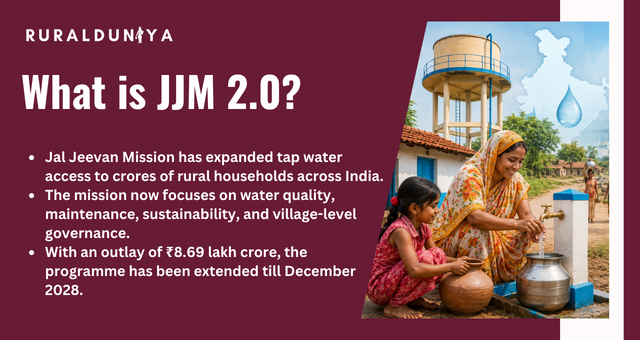
The Jal Jeevan Mission was launched in 2019 with the goal of providing Functional Household Tap Connections (FHTCs) to every rural household. Since then, crores of households have received tap water access across India.
However, the government realised that infrastructure creation alone is not enough. Many villages now require strong systems for maintenance, source sustainability, water quality monitoring and local governance.
Under the new restructured framework approved by the Union Cabinet in March 2026, the mission has been extended till December 2028 with a total outlay of ₹8.69 lakh crore. The central assistance has been increased significantly to support states in completing remaining coverage and strengthening rural drinking water systems.
Key Focus Areas of JJM 2.0
The biggest change in Jal Jeevan Mission 2.0 is the shift from “scheme construction” to “service delivery”.
The new operational model focuses on:
- Long-term rural water supply sustainability
- Assured and reliable water service delivery
- Operation and maintenance (O&M)
- Water quality monitoring and surveillance
- Community ownership and village-level governance
- Digital monitoring through dashboards and IMIS systems
- Strengthening Gram Panchayats and VWSCs
- Source sustainability and greywater management
According to the PIB release, JJM 2.0 aims to build an institutional ecosystem around rural drinking water instead of treating it only as an infrastructure project.
JJM 2.0 Fund Release and Budget
The Union Budget 2025-26 had already announced the extension of Jal Jeevan Mission till 2028. The budget allocation for the mission was enhanced to ₹67,000 crore, showing the Centre’s continued priority towards rural drinking water access.
Later, the Cabinet approved a much larger restructured outlay under JJM 2.0.
According to PIB, the total outlay under the mission has now been increased to ₹8.69 lakh crore, including enhanced central assistance of ₹3.59 lakh crore.
The new funding model is expected to support:
- Completion of remaining household connections
- Strengthening existing schemes
- Water quality infrastructure
- O&M systems
- Community institutions
- Source sustainability works
- Digital monitoring systems
States are also expected to sign reform-linked agreements and improve governance systems for efficient fund utilisation.
JJM 2.0 Operational Guidelines
The release of Jal Jeevan Mission 2.0 operational guidelines is another major development.
According to the Ministry of Jal Shakti, the new guidelines focus on structural reforms and sustainable service delivery.
Some expected themes in the operational guidelines include:
1. Functionality Over Infrastructure
The focus is now on whether water is actually reaching households regularly and safely.
2. Strengthening O&M Systems
Villages and Gram Panchayats will play a larger role in operation and maintenance.
3. Community Ownership
Village Water and Sanitation Committees (VWSCs) are expected to become stronger governance institutions.
4. Water Quality Surveillance
More emphasis is being placed on testing, monitoring and local water quality management.
5. Sustainability and Source Protection
Groundwater recharge, source strengthening and greywater management are becoming central themes.
JJM 2.0 Dashboard and Digital Monitoring
The government is increasingly using digital governance systems to monitor rural water supply performance in real time. Under Jal Jeevan Mission 2.0, dashboards are expected to become more integrated, data-driven and service-oriented.
The dashboard ecosystem is likely to focus on:
- Household tap connection status
- Scheme functionality
- Water quality testing
- Source sustainability tracking
- Village-level performance monitoring
- Fund utilisation
- O&M compliance
- Sensor-based monitoring in selected schemes
States and districts are also being encouraged to use decision-support systems and analytics for planning and monitoring rural water supply services.
JJM IMIS 2.0 and eJalShakti Login
Another major keyword gaining traction is “JJM IMIS 2.0” and “JJM 2.0 login eJalShakti”.
The Integrated Management Information System (IMIS) under Jal Jeevan Mission is expected to become more advanced in the next phase of the mission. The platform helps central and state governments track implementation progress, scheme performance and reporting.
The eJalShakti platform is used by officials, implementing agencies and state departments for:
- Scheme monitoring
- Data entry and reporting
- Fund tracking
- Dashboard access
- Village-level updates
- Water quality reporting
- Administrative approvals
With Jal Jeevan Mission 2.0, the IMIS system is expected to evolve beyond construction tracking and focus more on service delivery indicators and sustainability metrics.
JJM 2.0 O&M Market and Rural Economy
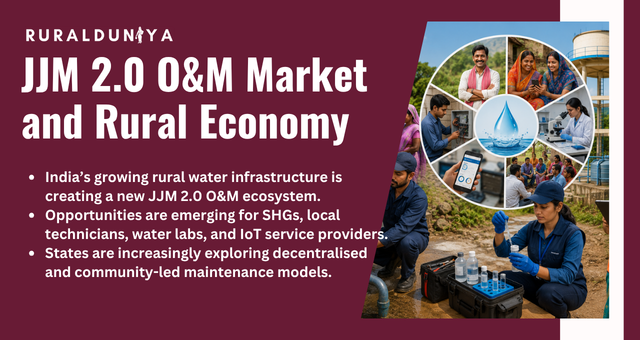
One important emerging discussion is the “JJM 2.0 O&M market”.
As rural water infrastructure expands across India, a large ecosystem of maintenance services, local technicians, water quality testing, monitoring systems and community-based management models is expected to grow.
This could create opportunities for:
- Rural entrepreneurs
- Women SHG federations
- Local technicians
- Sensor and IoT providers
- Water quality labs
- Community institutions
- Panchayat-level service providers
Several states are already exploring decentralised O&M models and community-led service delivery systems under the mission.
JJM 2.0 MoU and Reform-Based Implementation
The government has also started promoting reform-linked MoUs with states.
Recently, states such as Maharashtra signed reform-oriented agreements under Jal Jeevan Mission 2.0 focusing on sustainability, service delivery and community ownership.
These MoUs are important because they move the programme towards accountability-based implementation instead of only target-based execution.
The agreements are expected to focus on:
- Performance monitoring
- Functionality verification
- Governance reforms
- Water quality systems
- O&M sustainability
- Panchayat participation
Why JJM 2.0 Matters for Rural India
JJM 2.0 is not just an extension of an existing scheme. It represents a major policy shift in rural water governance.
The first phase focused on infrastructure expansion. The second phase focuses on sustainability, reliability and institutional strengthening.
For rural India, this means:
- Better long-term water security
- Improved governance systems
- Stronger village institutions
- Community-led monitoring
- Women’s participation
- Better public health outcomes
- Increased accountability in service delivery
As India moves toward universal rural tap water coverage, the success of Jal Jeevan Mission 2.0 will depend not only on pipes and infrastructure, but also on local governance, community ownership and sustainable operation systems.
FAQs
What is JJM 2.0?
Jal Jeevan Mission 2.0 is the extended phase of Jal Jeevan Mission focused on sustainable rural drinking water supply and long-term service delivery till 2028.
2. What is the JJM 2.0 dashboard?
It is a digital platform used to monitor tap water connections, scheme performance and fund utilisation under Jal Jeevan Mission.
3. What is JJM IMIS 2.0?
JJM IMIS 2.0 is the upgraded management and reporting system used for monitoring rural water supply schemes and implementation progress.
4. What is the budget for JJM 2.0?
The total approved outlay for JJM 2.0 is around ₹8.69 lakh crore.

Nishank is a social impact enthusiast with a solid foundation in public policy, micro-enterprise, and agribusiness. Growing up in a farmer’s family has given him a profound connection to rural communities, fueling his passion to empower people towards self-reliance. He completed his undergraduate studies at the Delhi University and earned a master’s degree in Rural Management from National Institute of Rural Development & Panchayati Raj in Hyderabad.