India’s rural employment system is witnessing one of its biggest proposed reforms in two decades. The Viksit Bharat – Guarantee for Rozgar and Ajeevika Mission (Gramin), commonly called the VB G RAM G Bill 2025, has been introduced as a new framework to replace MGNREGA and align rural employment with the government’s Viksit Bharat 2047 vision.
The bill has generated significant discussion among policymakers, UPSC aspirants, economists and rural development experts because it proposes major changes in rural employment guarantees, digital monitoring, funding structures and livelihood planning.
In this article, Rural Duniya explains the VB G RAM G full form, Act, bill provisions, UPSC relevance, comparison with MGNREGA, major features, benefits, concerns and overall impact on rural India.
What is VB G RAM G?
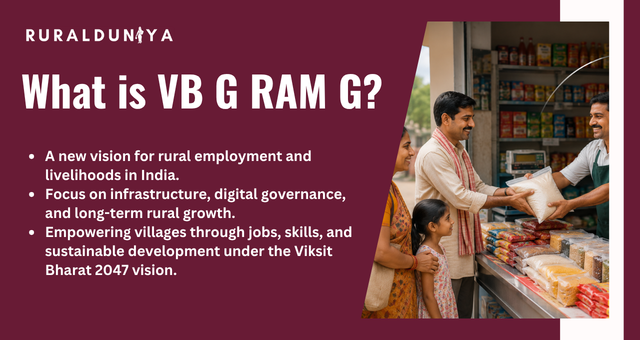
VB G RAM G stands for Viksit Bharat – Guarantee for Rozgar and Ajeevika Mission (Gramin). The proposed legislation aims to create a new rural employment and livelihood framework replacing the Mahatma Gandhi National Rural Employment Guarantee Act (MGNREGA), 2005.
The government says the bill is designed to modernize rural employment systems and integrate them with infrastructure creation, digital governance and long-term livelihood development under the Viksit Bharat 2047 vision.
VB G RAM G Bill 2025
The bill 2025 was introduced in Parliament in December 2025 as a replacement framework for MGNREGA.
The bill proposes:
- Increased employment guarantee
- Digital monitoring systems
- Outcome-based rural works
- Convergence with other schemes
- Infrastructure-linked rural development
- Skill and livelihood integration
The proposed law is considered one of the biggest reforms in rural employment policy since MGNREGA was introduced in 2005.
VB G RAM G Act
The Act is expected to officially replace MGNREGA from July 1, 2026 according to recent government notifications.
The Ministry of Rural Development has stated that implementation rules are being prepared in consultation with states and union territories.
The Act focuses on:
- Rural employment
- Livelihood creation
- Durable infrastructure
- Digital transparency
- Decentralized planning
The government describes it as a transition from wage-centric employment to livelihood-oriented rural development.
Benefits of VB G RAM G
Supporters believe the new framework may:
- Increase employment days
- Improve rural infrastructure
- Strengthen digital transparency
- Promote livelihood diversification
- Create durable assets
- Improve scheme convergence
The government also claims that digital monitoring may reduce corruption and improve implementation efficiency.
Why is MGNREGA Being Replaced?
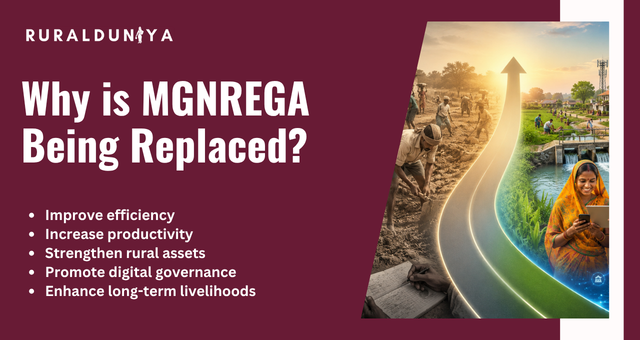
According to the government, changes in rural economies, digital systems and infrastructure needs require a modernized employment framework.
The government argues that the new framework will:
- Improve efficiency
- Increase productivity
- Strengthen rural assets
- Promote digital governance
- Enhance long-term livelihoods
However, critics believe the shift may weaken the rights-based nature of MGNREGA.
Major Features of VB G RAM G Bill
1. Increase in Employment Guarantee
Under MGNREGA:
- 100 days of work guarantee existed
Under it:
- Employment guarantee increases to 125 days annually.
This is one of the most important proposed changes.
2. Digital Monitoring Systems
The bill promotes:
- Digital dashboards
- Tech-based monitoring
- Online project tracking
- Digital job records
- Outcome-based evaluation
The government says this will improve transparency and accountability.
3. Infrastructure and Asset Creation
The proposed framework focuses more on:
- Durable rural assets
- Infrastructure creation
- Rural productivity
- Long-term development outcomes
This marks a shift from purely wage-based employment generation.
4. Convergence with Other Schemes
The bill encourages integration with:
- Rural housing schemes
- Water conservation projects
- Agriculture infrastructure
- Skill development programmes
- Rural livelihood missions
This convergence model aims to improve rural development efficiency.
5. Seasonal Employment Pause
One major proposal under the bill is a temporary pause in guaranteed employment during peak agricultural seasons to ensure labour availability for farming activities.
This has become one of the most debated provisions of the bill.
VB G RAM G vs MGNREGA
| Feature | MGNREGA | VB G RAM G |
|---|---|---|
| Employment Guarantee | 100 days | 125 days |
| Focus | Wage employment | Livelihood + infrastructure |
| Monitoring | Traditional systems | Digital dashboards |
| Asset Creation | Limited focus | Strong emphasis |
| Seasonal Pause | No | Proposed |
| Technology Integration | Moderate | High |
The proposed framework reflects a structural shift in rural employment policy.
VB G RAM G and UPSC
The bill is highly important for UPSC aspirants because it covers:
- Rural development
- Social welfare
- Employment policy
- Governance reforms
- Federalism
- Public administration
Important UPSC Topics
- MGNREGA reforms
- Rural livelihoods
- Digital governance
- Welfare state
- Fiscal federalism
- Labour rights
- Social protection systems
The topic may appear in:
- UPSC Prelims
- GS Paper 2
- GS Paper 3
- Essay papers
- State PCS exams
Criticism and Concerns
Several experts and opposition leaders have raised concerns.
Major Concerns
- Weakening of rights-based employment
- Increased state government burden
- Digital exclusion risks
- Reduced flexibility for workers
- Seasonal work pause concerns
- Centralized control
Some analysts argue the framework may shift from a demand-driven employment guarantee toward an administratively controlled system.
There are also concerns regarding implementation capacity in poorer states.
Impact on Rural India
The impact of VB G RAM G will depend heavily on implementation quality.
Potential Positive Impacts
- Better infrastructure
- More employment days
- Stronger digital governance
- Integrated rural development
Potential Challenges
- Technology access gaps
- Administrative complexity
- Reduced labour flexibility
- State-level implementation differences
The transition from MGNREGA to VB G RAM G represents a major shift in India’s rural policy framework.
Latest Updates on VB G RAM G
Recent government notifications indicate that:
- The framework may become operational from July 1, 2026
- Draft implementation rules are being prepared
- States are being consulted
- Digital monitoring systems are under development
The policy remains under active national discussion.
Why VB G RAM G Matters
The VB G RAM G Bill is not just a rural employment reform. It reflects a broader shift toward:
- Digital governance
- Infrastructure-led development
- Outcome-based welfare systems
- Integrated livelihood planning
If implemented effectively, it may reshape rural employment and development systems across India for the coming decades.
However, its success will depend on:
- State cooperation
- Financial sustainability
- Transparency
- Worker protection
- Inclusive implementation
FAQs
What is the full form of VB G RAM G?
It stands for Viksit Bharat – Guarantee for Rozgar and Ajeevika Mission (Gramin).
Will VB G RAM G replace MGNREGA?
Yes, the proposed framework is expected to replace MGNREGA from July 2026.
How many employment days are proposed under VB G RAM G?
The bill proposes 125 days of guaranteed employment annually.
Why is VB G RAM G important for UPSC?
The topic is important for governance, rural development, welfare policy and public administration preparation.

Nishank is a social impact enthusiast with a solid foundation in public policy, micro-enterprise, and agribusiness. Growing up in a farmer’s family has given him a profound connection to rural communities, fueling his passion to empower people towards self-reliance. He completed his undergraduate studies at the Delhi University and earned a master’s degree in Rural Management from National Institute of Rural Development & Panchayati Raj in Hyderabad.